



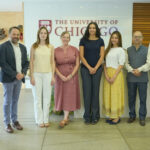
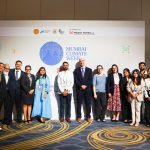
This fall, 19 UChicago students experienced the realities of the climate and growth challenge firsthand through a new experiential learning course. During the three-week September Term, the students traveled to Midland, Texas; Albany and New York, New York; and Delhi, India to meet with the people who are shaping—and shaped by—the challenge.
The course is a core component of the Chicago Curriculum on Climate and Sustainable Growth, which is the foundation for two new degree programs: the Climate and Sustainable Growth major, now in its second year, and the Master of Science in Climate and Energy Policy (MSCEP), a partnership between the Harris School of Public Policy and the Institute for Climate and Sustainable Growth that is just kicking off its first year. The course is an initiative of the Polsky Energy Transition Leadership Academy.
“The Chicago Curriculum aims to give students a 360-degree understanding of the challenges society faces in balancing its climate and sustainable growth goals—the science, technology, policy—all of which are legitimate perspectives and all of which you have to pull together,” says Michael Greenstone, the director of the Institute who leads the Chicago Curriculum.
“A really integral part of this Curriculum is the acknowledgment that experiential learning plays such an important part in the learning process,” says Gabriel Presler, executive director of MSCEP.
West Texas: Understanding the economy behind energy development
The first stop was West Texas, home to the Permian Basin, one of the world’s most prolific oil fields. The students saw firsthand how the fossil fuel industry has both shaped the global energy economy and built entire communities around its production.
“It’s easy to take a negative perspective and think about oil and gas in terms of the climate problem,” says Conor Carney, the Institute’s director of Undergraduate Programming. “But it does pay for communities to thrive and individuals to have meaningful livelihoods. That’s a piece that is important to the course as students grapple with questions like ‘Why do we rely on oil and gas?’”
At the Petroleum Museum, the students traced the industry’s history and its role in building the region’s economy and identity. Local energy consultants discussed the Permian’s importance to U.S. and global energy markets and the challenges that come with its growth, including polluted water, orphaned wells and resource conservation. A meeting with the Chairman of the Texas Railroad Commission, which regulates the state’s oil and gas industry, highlighted how dependence on fossil fuel revenues can make the transition to new technologies politically difficult.
Site visits made these trade-offs concrete. At Occidental Petroleum, the students learned how hydraulic fracturing works and looked at its associated challenges, such as water and air pollution and methane emissions. At Kinetik, they saw the infrastructure used to gather, process and transport the natural gas and natural gas liquids, and learned how pipeline capacity and market access influence production decisions. A visit to ENGIE’s Big Sampson Wind Farm gave them new insights on how renewable energy is playing a bigger role in the grid and local economy, and is being used to augment the production of fossil energy.

“It’s just super valuable for students to actually speak to the people there, both management and the on-the-ground workforce,” says Ryan Kellogg, director of MSCEP and the Deputy Dean for Academic Programs at the Harris School of Public Policy. “When we think about the energy and climate challenge, yes, we can put numbers on things and do a cost-benefit analysis, but at the end of the day, people are involved, and people will bring their values into the rooms in which decisions are ultimately made.”
MSCEP student Anna Wollaeger learned from those people that changing the way energy is produced means coming to terms with the local economic interests that have been built around fossil fuels.
“In Texas, people don’t know how to live without the oil and gas sector, and if you’re like me and you’re from the Midwest, that notion feels foreign to you,” Wollaeger says. “If you’re planning to be in policymaking, it’s important that you have an idea of how the decisions you make will impact people. The September Term is a place where you really get to experience that firsthand.”
New York: Understanding what it takes to finance and power the energy transition
For the second segment of the course, the students traveled to New York, where they met with the financial institutions deciding which energy projects to invest in, the grid operators responsible for delivering reliable electricity, and the policymakers who influence those decisions.
At Blackstone, the students heard from the Institute’s Advisory Group Chair, David Foley, the Sr. Managing Director and Global Head of Blackstone Energy Transition Partners. Foley explained how capital allocators evaluate energy projects and decide which projects to pursue and which to pass on based on the private returns to those investments.
“The students learned about the nature of patient capital. In some cases, these investments have run over seventeen years, as big institutional asset managers have worked to bring clean energy into New York City,” says Presler. “That process of seeing in action the professionals who are working to bring energy technologies to market really made the economic and financial concepts the students learned in the classroom come alive.”

The students also visited KeyBanc Capital Markets and JP Morgan Chase. A discussion with JPMorgan Chase’s lead climate scientist Sara Kapnick deepened their understanding of how banks incorporate climate science into financial decisions.
Zoe Springsteen (College ’27), a Climate and Sustainable Growth major, found the conversation with Kapnick especially pivotal: “She totally reorganized how I think about my work. I knew before I went into the September Term what I would be doing after I graduate. But I wasn’t thinking about how it would fit into the bigger picture of issues in the world.”
The students went inside the systems that manage and distribute electricity. They visited the New York Power Authority’s Smart Operations Center, where they saw how operators monitor the state’s power system in real time, and its Advanced Grid Innovation Laboratory, where simulation and testing help speed grid modernization. At the New York Independent System Operator (NYISO), they learned how grids maintain reliability while meeting the state’s decarbonization mandates. A visit to the Mayor’s Office of Climate and Environmental Justice showed how the local government works with the private sector and the role of government in advancing energy and climate solutions.
“Those experiences inform what we discuss in the classroom,” says Kellogg. “Right now I’m teaching the class in energy and environmental markets, and when we talk about the economics of how grid dispatch works or how you form a merit order out of the grid, we look back to the experience they had on the trip where they saw in fine detail the technical and financial challenges wrapped up in maintaining reliability and bringing in renewables.”
Altogether, the time in New York showed that the energy transition requires more than new technologies; it also involves mobilizing capital for new infrastructure, modernizing existing systems, managing risk, and coordinating decisions between public and private institutions.
India: Understanding the realities of energy access and climate impacts
For the third and final segment, the students traveled to India where they learned how the country is working to lift people out of poverty by increasing energy access while addressing air pollution and climate change. Seeing firsthand how limited access to electricity shapes daily life and how climate change threatens communities helped students understand why balancing climate and growth goals is so complex.
“By traveling to communities experiencing energy poverty or where electricity may not be reliable or where there is significant exposure to environmental hazards, whether from climate or local pollution, students can understand on the ground what it really feels like to be in that kind of situation in a way that’s much harder to communicate through readings or classroom instruction alone,” says Carney.
At the Chintan Research Foundation, the students learned why coal remains central to India’s power supply. Its low cost helps meet the country’s growing energy needs, even as India invests in renewable energy and works towards its climate goals. To meet those climate goals, officials from the Ministry of Environment, Forest and Climate Change explained how they evaluate climate effects on the ground, from heat and water resources to agriculture, and how this informs their policy.
Another challenge in India is air pollution. Meetings with Delhi’s Commission for Air Quality Management and the Central Pollution Control Board explored the challenges of controlling air pollution and the innovative approaches that are being pursued to tackle it. As one example, the students learned about the world’s first particulate market in Surat, Gujarat, a project conducted in partnership with UChicago researchers.
Two days with Tata Power gave the students a closer look at how India is expanding electricity access, and the financial and operational challenges utilities are encountering such as distribution losses and electricity theft. They also saw how India is integrating renewables. On a rural field visit, they toured a one-megawatt solar plant and a microgrid to learn how the utility extends reliable electricity to rural communities and integrates rooftop solar. From this they grew to understand how the success of an energy solution is dependent on much more than the technology itself.
For College student Springsteen, visiting a family that had worked with a local utility to implement a solar program made the lessons tangible.
“It’s one thing to sit in Climate Crossroads and hear from Hina Khar, who’s from Pakistan, what their unique energy challenges are and, for example, how they get solar up and running. It’s another thing to go to a nation like India and see how solar is implemented by visiting with a family that interacted with the local utility and implemented the program,” says Springsteen. “This experience changed my perspective.”

Connecting the lessons and learning how to learn
Together, the three segments of the course gave the students a broader perspective of the climate and growth challenge—from the economic realities of energy production in West Texas, to investment and grid management in New York, and the challenges of expanding affordable, reliable energy while addressing pollution and climate change in India.
“With all of those components combined, students start to make connections and they start to understand that the fundamental problem of the climate and growth challenge is that it looks very different for individuals depending on where they’re located,” says Carney. “In understanding how others think and why they think that way, students leave with the tools and understanding to appreciate and respect different perspectives and begin to recognize their own limitations of their points of view.”
This was the lesson MSCEP student Wollaeger took away from the course: “Coming in, I had my own ideas about what the climate challenge was, what steps we should take to solve it, and the September Term was really a chance to challenge those perspectives and talk to people who totally disagree with me, and it really changed the way I think.”
That is the ultimate aim of the course and the broader Chicago Curriculum, says Institute Director Michael Greenstone. Students need to develop this deeper understanding of the challenge and of themselves so that in their careers and in their lives they can approach people and problems with an open mind and develop solutions that account for many different perspectives and tradeoffs.
“The highest goal of education is for people to learn how to learn,” Greenstone says. “Yes, the climate and sustainable growth conundrum that society faces is important in its own right, but even more important is that students leave with an understanding of how to tackle new problems, hard problems, problems that aren’t black and white, problems that are gray. And if they can leave with that, we will have done our job.”